🎉 Happy Birthday Uncle Charlie. Thanks for your life filled with service. 🎂
Celebrating Charlie Douglass at 86
A Fuller Road Story of Place, Purpose, Longevity, and a Life Still Moving Forward
August 31, 2026 | Hayneville, Alabama → Montgomery, Alabama → Eighty-Six Years of Purpose
This morning, around 8:00 a.m., I called my Uncle Charlie to wish him a happy 86th birthday. I asked him a simple question: "What do you have planned for today?" His answer was just as simple. He was going to the gym. At 86 years old. In some ways, that one answer tells the story.
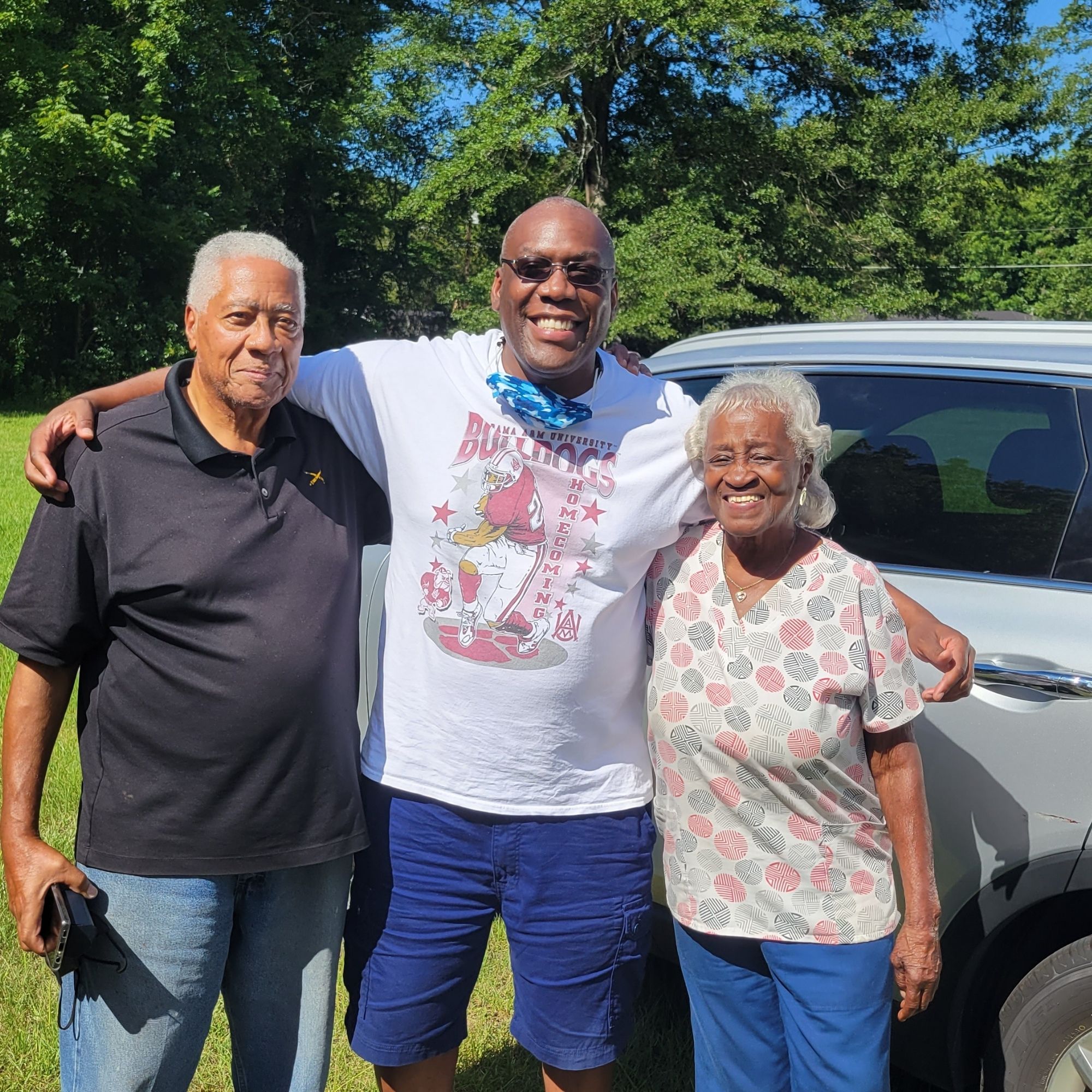
Left to right: Uncle Charlie Douglass, Art Fuller, and Aunt Liz — all still living, all still connected to service. Photographed on Fuller Road in Montgomery, Alabama, July 2022.
86
Charlie's Age
August 31, 2026
65.8
Lowndes Co. Life Exp.
years (2021)
488K+
Study Participants
purpose & mortality
~30%
Lower Mortality Risk
with greater purpose
Born Into a Place That Matters
Charlie Douglass was born on August 31, 1940, in Hayneville, Alabama, the county seat of Lowndes County. That geography is not a footnote to his story. It is part of the story.
The Fuller and Douglass family history documented in Fuller Road: The Science of Purpose reaches through Hayneville and Lowndes County and into Montgomery for generations, extending to the early 1900s, the 1920s, and through family genealogy much farther back.
Fuller Road explicitly recognizes Uncle Charlie's memories of walking barefoot to school, working alongside Great-Grandmama, and building a life of dignity in the face of systemic oppression as central to the family's historical narrative.
These were not people who happened to pass through Alabama. They lived there. They raised children there. They owned land there. They attended schools and churches there. They worked there. They endured segregation there. And many remained connected to these communities throughout their lives.
That matters enormously when we begin asking questions about longevity.
From Hayneville: Five Miles Toward an Education
Charlie grew up in Jim Crow Lowndes County. As a young child, his mother traveled north to New York for employment, part of the broader migration pattern that reshaped African American families throughout the twentieth century. Charlie remained in Alabama within a multigenerational family network and was especially close to his great-grandmother, Mamie Peterson.
That experience gave him something that would become extraordinarily valuable later in life: proximity to elders. He walked with them. He listened to them. He learned names, relationships, places, property histories, churches, and family stories.
Charlie recalled walking approximately five miles to school. A white school was much closer. He could see a school he was legally prohibited from attending while traveling much farther to reach the school available to Black children.
There were occasions when Black children walking to school were harassed by white children passing them on buses. Charlie remembered taking alternate roads to avoid it. And for a significant part of childhood, shoes were not something casually worn every day.
He walked. He learned. He continued. Then the school burned. Rather than ending his education, the disruption eventually helped redirect Charlie toward Montgomery and Carver High School — where he discovered basketball, brick masonry, electronics, and technical problem-solving.
From Alabama to Germany — and Back Again
Charlie graduated from high school in 1959 and attended Alabama State University. Ironically, he initially did not want to become a teacher. Life had other plans.
After leaving college, Charlie entered military service and spent four years in Germany during the Cold War era. His technical experience included electronics and radio-related work. When his service concluded, a recruiter encouraged him to reenlist. Charlie declined. Four years were enough.
He returned to civilian life with technical knowledge, experience, and a broader view of the world than the boy from Hayneville could have imagined. And then something interesting happened. The man who had not wanted to become a teacher became one.
The Teacher Who Found His Own Way to Teach
Charlie didn't simply become a classroom teacher. He taught something he understood and enjoyed: electronics. Technical knowledge acquired through experience became knowledge that could be passed to young people.
He taught generations of students in Lowndes County. Decades later, former students still remembered him. Some remained in contact. Some called. Some sent gifts. They remembered what happened in his classroom.
That gives Charlie's career a significance that cannot be captured simply through years of employment. The real measurement came years later: Did somebody remember what you gave them? For Charlie, the answer was yes.
And that introduces one of the major ideas running throughout the Fuller family story: Knowledge is not supposed to stop with the person who possesses it. It is supposed to move forward.
Builder. Craftsman. Land Steward. Family Historian.
Teaching was only one dimension of Charlie's life. He also developed skills in construction, electronics, property, business, and practical problem-solving.
Land carried particular significance. The Douglass-Peterson family history includes Black land ownership in Lowndes County at a time when many Black agricultural families remained trapped within systems of tenancy and sharecropping. That meant property was never merely real estate. It represented independence, security, history, family continuity, and something that previous generations had sacrificed to preserve.
As he grew older, another role emerged. He became a keeper of memory. At an advanced age, Charlie could still identify relatives several generations removed from himself, explain family relationships, describe property transfers, remember who raised whom, identify churches and schools, and help reconstruct a family history stretching backward approximately two centuries.
That makes him something more than an elderly relative. He is a living archive.
Then We Noticed Something Else
As Fuller Road documented more of the family, an unusual pattern began to emerge. It was not only Charlie. A substantial number of Fuller and Douglass relatives from approximately the same generation were reaching their late seventies and eighties.
The book's longevity section identifies eight central Fuller/Douglass relatives who reached at least approximately 79, with most reaching 80 or older. It also identifies previous generations in which family members reached their eighties and nineties.
That included people connected to both sides of this Alabama geography: Hayneville/Lowndes County and Montgomery/Montgomery County. The family pattern becomes especially interesting when compared with the health environments of those places.
Why Hayneville Makes Charlie's 86 Years More Significant
According to the Alabama Department of Public Health, life expectancy at birth in Lowndes County in 2021 was just 65.8 years. The same state profile recorded a population of fewer than 10,000 residents and showed that the large majority of residents were classified as Black and Other.
That 65.8-year figure demonstrates something important: Lowndes County is not historically or presently a place associated with unusually high longevity. Even two decades earlier, the Alabama Department of Public Health recorded Lowndes County life expectancy at 70.9 years in 2000.
So Charlie reaching 86 is notable not merely because 86 is an advanced age. It is notable because of the environment from which his life began.
And 1940 Was a Very Different Time to Be Born
Historical health data show that in 1940, life expectancy at birth among Black Americans nationally was approximately 52.26 years for males and 55.56 years for females. White Americans at the time had substantially higher life expectancy — approximately 62.81 years for males and 67.29 for females.
Those historical figures must be interpreted correctly. Life expectancy at birth reflected extremely high infant and childhood mortality as well as the broader health inequalities of the period. Once someone survived childhood and reached adulthood, their remaining life expectancy changed.
But the statistic tells us something extremely important about the mortality environment into which Charlie was born. He was born a Black male in Alabama in 1940. He was born in rural Lowndes County. He grew up under segregation. Access to healthcare, educational opportunity, economic mobility, transportation, and other resources was profoundly unequal.
Against that background, reaching 86 — and remaining active — is worthy of serious attention.
Montgomery Tells a Related but Different Story
The other major geographic anchor of the family is Montgomery. Montgomery County historically offered more urban infrastructure and healthcare resources than rural Lowndes County, but it was still shaped by segregation and substantial racial and economic disparities.
In the same 2021 Alabama Department of Public Health profile, Montgomery County life expectancy at birth was 71.8 years — approximately six years higher than Lowndes County's 65.8 years, but it still places the family's Montgomery branch within a context where reaching the eighties is meaningful.
The manuscript describes relatives growing up together on Fuller Road and maintaining connections across many decades. It portrays Fuller Road not simply as a street, but as a network of family, caregivers, church relationships, friendship, practical support, shared history, and belonging. That may be scientifically important. Because modern longevity research increasingly demonstrates that relationships matter.
What Does Science Say?
The Fuller story cannot prove why members of this family lived as long as they did. Genetics must remain part of the explanation. So must medical care, socioeconomic circumstances, chance, health behaviors, education, physical activity, environment, and many other factors.
But science points toward several factors that look remarkably familiar when placed beside the Fuller story. One of them is purpose.
In July 2026, researchers published one of the largest analyses to date examining purpose and mortality. The meta-analysis included 25 samples, 488,765 participants, 48,928 deaths, and up to 32 years of follow-up.
People reporting greater purpose in life had an approximately 30% lower risk of earlier mortality in the primary analysis. The association weakened but remained significant after accounting for physical activity, smoking, hypertension, diabetes, obesity, and other clinical and behavioral factors.
Most relevant to the Fuller story, the researchers found that the association between greater purpose and lower mortality was also present among Black participants. That does not mean purpose causes longevity. It means purpose belongs in the conversation.
What Purpose Looks Like in the Fuller Story
The scientific definition of purpose can sound abstract: a sense that one's life has direction and meaningful goals. Charlie makes it concrete.
Purpose can look like getting up and going somewhere. Having somebody who expects you. Maintaining your home. Teaching someone. Remembering a name nobody else remembers. Protecting family property. Going to church. Calling a former student. Talking to a nephew. Telling a story. Cutting the grass. Going to the gym. Having another reason to get up tomorrow.
At 86, Charlie still has reasons to participate in his own life. That may be the most important part of this birthday story.
Purpose, Belonging, and Mattering
The Fuller story suggests that purpose rarely exists by itself. It sits inside relationships. The Fuller and Douglass elders repeatedly occupy meaningful roles: teacher, parent, grandparent, uncle, aunt, church member, neighbor, land steward, caregiver, historian, mentor, friend.
Those roles create something researchers increasingly describe as mattering. You matter because somebody needs something you possess.
For Charlie, people still need what he knows. Family members need his memories. Former students remember his teaching. Younger generations need his history. His property requires stewardship. He still has somewhere to go.
That combination — purpose + relationships + mattering + activity — offers one of the strongest scientific hypotheses emerging from the Fuller family story.
Perhaps Purpose Works Through Movement
Purpose does not have to operate as some mysterious biological force. It may help organize behavior. Consider a possible pathway: Purpose → Engagement → Behavior → Health.
If you believe there is somewhere worth going, you get up. If you get up, you move. If you have relationships, you interact. If people depend on you, you remain involved. If you maintain property, you solve problems. If you exercise, your body continues working. If people ask you questions, your memory remains engaged. If younger generations want your stories, you continue telling them.
Purpose may therefore matter partly because it keeps human beings participating. The 2026 mortality research is consistent with this possibility: behavioral and clinical factors explained part — but not all — of the association between purpose and mortality.
And this is why Charlie going to the gym at 86 is more than a charming birthday detail. It is a behavioral expression of continued engagement.
The Fuller Longevity Question
The most responsible conclusion is not: "The Fullers live longer because they have purpose." We cannot scientifically establish that.
The better question is much more interesting: Why does advanced age appear repeatedly among members of a family rooted for generations in Hayneville/Lowndes County and Montgomery, Alabama — and what combination of genetics, family connection, social support, physical activity, education, faith, meaningful work, property stability, adaptability, generativity, and purpose might help explain it?
That is a legitimate research question. And it is especially compelling because geography makes the pattern harder — not easier — to dismiss.
Lowndes County reported life expectancy of 65.8 years in 2021. Montgomery County reported 71.8 years. Charlie is now 86. Charlie emerged from a place where long life has historically not been equally distributed. And he is still here.
86 Years — and Still Moving
Which brings us back to this morning. August 31, 2026. Around 8:00 a.m. A nephew calls his uncle on his birthday. "What are you doing today?" The answer: Going to the gym.
There is something almost poetic about that answer when we know the rest of the story. The child who once walked miles to school is still walking. The boy whose educational route was dictated by segregation kept going. The student whose school burned kept learning. The young man from Hayneville traveled all the way to Germany. The man who didn't want to teach became a teacher remembered by students decades later. The craftsman kept building. The land steward kept protecting. The family historian kept remembering. And the elder keeps moving.
Maybe that is one of the deepest lessons of Fuller Road: Purpose does not have an expiration date. At 86, purpose may be as simple and as profound as knowing: I still have somewhere to go today.
Happy 86th Birthday, Uncle Charlie.
Charlie Douglass's life is worth celebrating because of what he has accomplished.
But it is also worth studying because of what his life may help us understand — about Hayneville, about Montgomery, about Black Southern history, about family, about resilience, about relationships, about aging, about movement, about belonging, and perhaps, increasingly, about the science of purpose.
The story is not finished.
Keep moving.