
Your DrPH Cohort Checklist
Every student in the Mercer DrPH Research Cohort does the same steps. Each step builds on the one before it and gets you ready for your Applied Practice Experience. Use the links below to finish each step. Once you join the cohort, your progress is tracked for you.
APE connection: these steps prepare your own project. Your analysis, your presentation, and your paper are your own work, and your project answers one question two ways, with numbers and with words.
Set Up Your Account
Answer three quick questions about yourself: what inspires your purpose, how you want to help others, and two words (plus an emoji) that describe you. They are optional, and preferred. They shape your 8-week guide, and nothing else in the program waits on them.
Join the cohort to trackSign Your APE Agreement
Read each expectation and put your initials by it. Then sign your Applied Practice Experience agreement. The agreement holds the commitments for your placement at the Applied Purpose Science Research Lab.
Join the cohort to trackRead the Introduction to Where the Data Comes From
Read the background story. It shows where the Voice Up data comes from and why it matters. When you finish, check the box on the page to say you read the introduction.
Join the cohort to trackExplore the Research Behind Voice Up
Voice Up rests on peer-reviewed evidence. Work through the three research sections: the Research Behind Voice Up hub, the RAND Study, and the Loneliness Brief. Then check the box on the page to mark Step 2B complete.
Join the cohort to trackPick Your Research Area
Look at the five research workstreams. Choose your two favorites and tell us why each one draws you. We use your choices to assign your workstream.
Join the cohort to trackRead & Acknowledge: your responsibilities as a researcher (unlocks the Data Library)
Transcript corpus (forthcoming — separate acknowledgment required)
These steps are for students enrolled in the DrPH Research Cohort (Mercer). Sign up for the cohort to unlock tracking.
Stuck on a step? Submit a help ticket and we’ll fix it fast — or email info@ellingtonbooks.com.
Having trouble? Submit a help ticket and we’ll get it fixed as quickly as possible — or email us directly at info@ellingtonbooks.com. We welcome the outreach.
Get HelpVoice Up in the spotlight. Our founder Art Fuller is the featured presenter at Georgia State University’s APE Partner Spotlight on Tuesday, October 20 — sharing Voice Up’s APE opportunities with public health students during APECS Week.
Learn moreVoice Up's Official Documentation of Record
This platform is Voice Up's official documentation of record for your Applied Practice Experience. It supports — but does not replace — the larger APE Agreement between you, Mercer University, and Voice Up Publishing. Every action below is saved as a confirmed, time-stamped record that both students and staff can check at any time.
Signed Online
Your agreement is signed here — initials, name, and date saved instantly.
Time-Stamped
Every action — joining, signing, selecting — records the date and time.
Communications Confirmed
Notes, questions, and evaluations are stored — nothing is lost.
Download Official Copies
Print-ready HTML of your signed agreement or evaluation, anytime.
The Applied Purpose Science Research Lab @ Voice Up
When you join, you are automatically opted into this research collaborative group. The lab is the research and evaluation home for your work — it studies how purpose, well-being, participation, leadership, mentoring, and real-world production develop over time.
Purpose Before Prestige
The lab studies purpose as a practice — not a status label.
Ethics & Dignity First
Participant ownership, opt-in publication, and de-identification by default.
Collaborative by Design
Researchers, practitioners, and students work together on real questions.
The lab provides the research framework, the controlled data environment, the organizational questions, and the process for returning findings to practice. It is grounded in the Voice Up University Charter and the emerging field of Applied Purpose Science.
Read the Charter Background
Read the official founding charter and governance framework for the lab, plus the field definition and university charter your work builds on.
Your Applied Practice Experience at a Glance
These details match your official APE Agreement. Review them here, then sign your agreement to confirm your placement.
Time Commitment
Approx. 7.5 hrs/week for 8 weeks
Minimum Hours
60 contact hours required
Course
DPH 808 — Applied Research Methods & APE
Preceptor
Arthur L. Fuller, Jr.
Read the Introduction to Where the Data Comes From
Learn the background story and the significance of the dataset you will study.
The Background Story on Voice Up and the Data
How this initiative began — and why the dataset you will study is so unusual.
In October of 2024, the founder, Art Fuller, reached a transition point in his career. He started lifting up youth, teens, and young adults through real conversations in small groups. Within 30 days, interest was so high he was receiving one application every 15 seconds for a free internship. The data he collected opened the door to a new way to measure purpose within individuals and communities.
This is the origin of the dataset you will study. The full background story — including the anchor image of Art, Uncle Charlie, and Aunt Liz on Fuller Road in Montgomery, Alabama — is on its own dedicated page. You can also read the full story of the founder on the About the Founder page.
Once you've read the background story, continue to the significance of the dataset below.
The Significance of the Data
This is not a textbook exercise. The data is real, the people are real, and what you find can unlock real change.
Voice Up Publishing Inc. is your host organization. The Applied Purpose Science Research Lab is your research setting. Together they have built a living dataset — a real record of how people find purpose, use writing, and grow healthier over time.
The data is already here. What it needs is you. Your analysis can unlock what the numbers are quietly showing: how purpose protects health, how writing helps people heal, and how public health programs can reach more people more effectively. The research backing these questions already lives on this site.
You are not starting from zero. You are joining a research lab that has been running — and your work helps turn what we have collected into proof that can help real communities.
A Living Record of Real People
3,519
Participants
6,201
Participation Records
10
Countries
What the Dataset Holds
The current workbook contains 24 worksheets across the three released workbooks — orientation materials, a codebook, summary statistics, audit metrics, a predictive-model summary, a verified-producer registry, governance tools, and de-identified records from multiple Voice Up instruments.
These figures remain subject to the reconciliation tasks identified in the workbook's issue log.
Purpose, Writing & Public Health
Three areas where your analysis can turn data into impact — each backed by research already on this site.
Explore the Research Already Here
Before you pick your research themes, see the evidence that already backs this work. These pages hold the studies, the stories, and the science your analysis will build on.
Explore the Evidence-Based Research & Learning Modules
Read the peer-reviewed briefs Voice Up is founded on, then explore the opportunities across all learning modules.

The Mental Health and Loneliness Epidemic
Around the world and in the United States, loneliness and mental illness are reaching record levels. The U.S. Surgeon General says loneliness is as deadly as smoking 15 cigarettes a day. Nearly 1 in 2 U.S. adults report feeling lonely. This page shares the latest evidence — and what we can do together.
1 in 2
U.S. adults feel lonely
26%
Higher risk of early death
1 in 8
People live with a mental disorder
The AI Gap — Why a Screen Is Not Enough
The RAND Corporation published a nationally representative survey in JAMA Pediatrics finding that 19.2% of U.S. adolescents and young adults (ages 12–21) reported using AI chatbots for mental health advice in 2025. Among those users, 42.8% turned to chatbots at least monthly, and 91.7% rated the advice as somewhat or very helpful.
Yet most young people kept it secret: 63.3% did not disclose chatbot use to anyone. Use was more common among females, older youth (18–21), and those who had already spoken with a clinician. RAND underscored the need for parents and clinicians to proactively discuss chatbot use — promoting safety, appropriate expectations, and links to evidence-based care.
What this means: Young people are reaching out for mental health support — but too many are reaching out to a screen instead of a person. AI can share information. It cannot form a real relationship. It cannot look you in the eye, sit with you in silence, or truly care. That gap is dangerous.
The Human Layer Voice Up Adds
Voice Up is committed to adding the human layer to this epidemic. The human layer is what can truly make the difference — a real conversation with a real person, forming a real relationship in a safe community. No chatbot can replace the feeling of being heard, understood, and valued by another human being.
Our programs pair every participant with mentors, peers, and purpose-driven cohorts. We create the safe spaces where real conversations happen — the kind that research shows actually heals. Technology can open a door. A person walks through it with you.
Explore All Voice Up Projects
The All Learning Modules page gives you the big-picture overview of every type of project Voice Up is currently involved with — learning modules, internships, fellowships, media networks, and community initiatives. Take your time and really dig into the options that are available.
For your research: This is where you see the full landscape of Voice Up's work and find the data that connects to your research themes.
For your own path: If there are projects you yourself are interested in participating in or contributing to, just let Voice Up know, and that process begins.
Explore Every Voice Up Project
Voice Up keeps growing new kinds of projects. We are looking for purpose-driven talent: people who share our core principles and want to try new things that lift others up.
Our Five Core Principles
These guide everyone who works with us. Tap one to jump straight to its modules.
Visit the All Learning Modules page and look through it all: every module, internship, fellowship, media network, and community project. As we grow, more openings come up for talented people who lift others and connect purpose:
Part-Time Consulting
Lend your skills to live projects on a flexible schedule.
Grant Opportunities
Go after funded research and program grants that fit your work.
Grant Writing
Help write proposals that bring new ideas to life.
Strategic Initiatives
Work with us on planned projects of all shapes and sizes.
See a project that fits your passions and skills and our principles? Tell Voice Up. A short talk is where new openings begin.
Interested in an opportunity? Book a time to talk with us directly.
Learn the Data Research Themes & Pick Your Top Two
Read the five workstreams, select your two favorites, and tell us why each one interests you.
Sign in to complete Step 3
You need a free Voice Up account to submit your research theme preferences. Complete Step 1 at the top of this page first.
This is what the pathway looks like — and the team is watching for who's next.
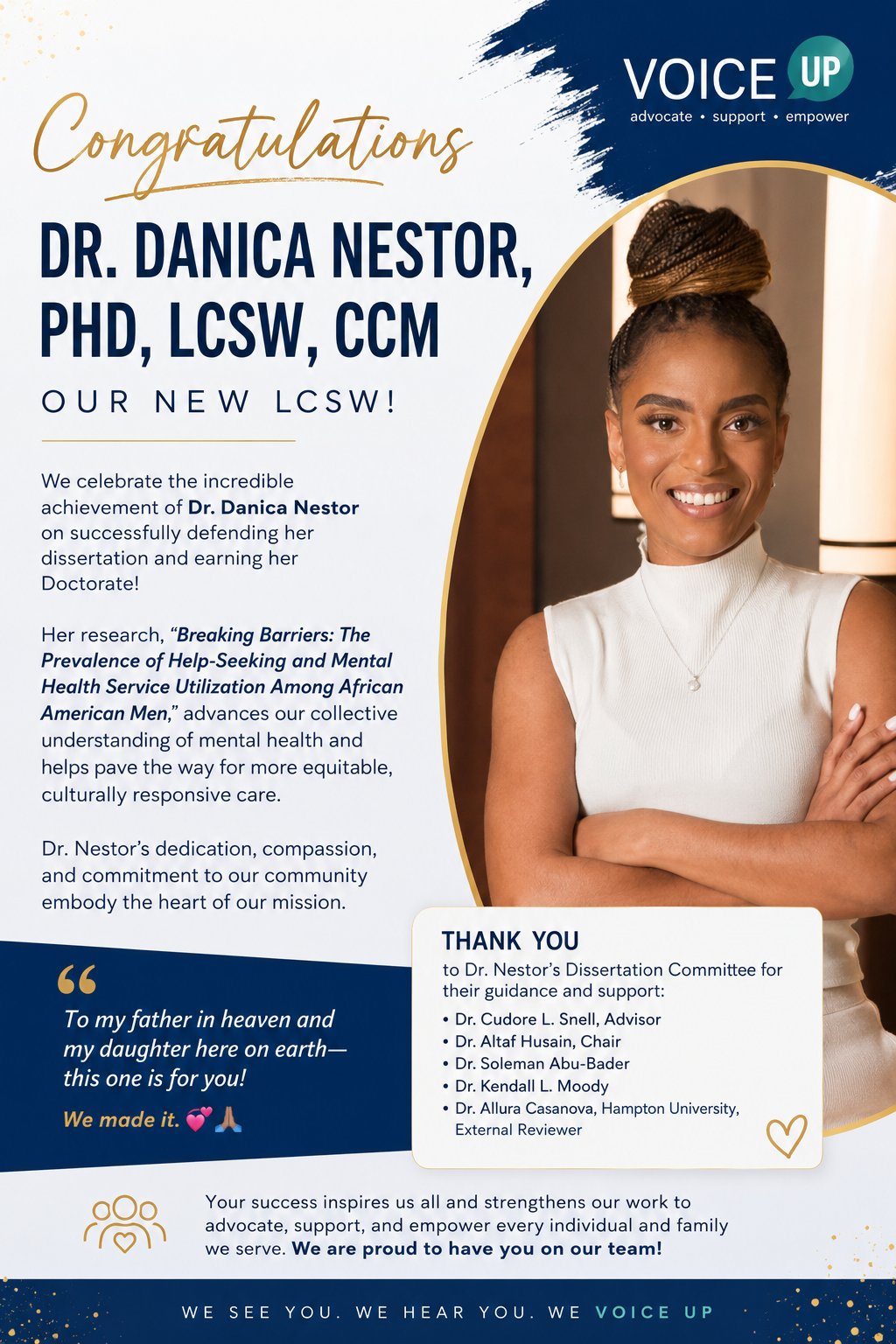
Dr. Danica Nestor, PhD, LCSW, CCM
Dissertation: "Breaking Barriers: The Prevalence of Help-Seeking and Mental Health Service Utilization Among African American Men" — Howard University School of Social Work (advisor Dr. Cudore L. Snell), defended June 15, 2026
Born in Haiti and raised in Florida and Georgia, Dr. Danica Nestor pivoted from the nursing track at Florida Atlantic University to social work, earned her MSW at Clark Atlanta University's Whitney M. Young Jr. School of Social Work — the first Black social work school in the country — and completed her PhD at Howard in seven years through COVID as a mom. Now a director at an Emory University Hospital and a Voice Up mentor, she lives the motto "Find a way or make one."
We look forward to creating a similar profile of your work and future success pathway ahead.

Sign Up for Our Newsletter
Get purpose-driven updates, new opportunities, and community stories delivered straight to your inbox. It's free, and it's one more way to stay connected to the movement.