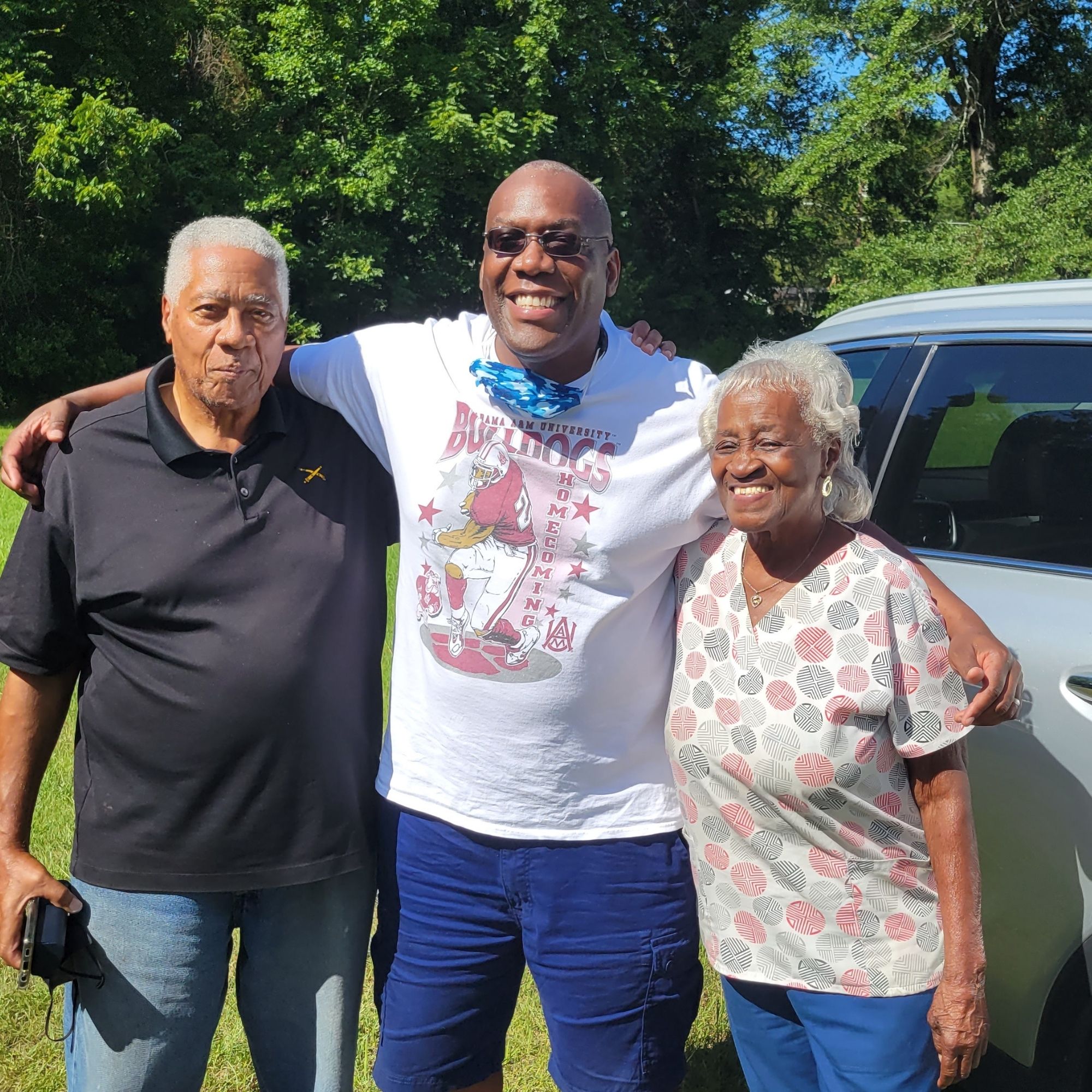
Fuller Road, Montgomery, Alabama — the family history that grounds Voice Up's work.
Georgia State University — Research Methods Guest Session
On September 24, 2026 — one day after the Mercer DrPH introduction — Art Fuller was the first guest in a Georgia State University research methods class. Where the first Georgia State lecture spoke to a public health careers class, this session spoke to a small undergraduate class as prospective participants, and it tied Voice Up's work directly to research, evaluation, and the skills the course teaches. This page preserves the minutes of what was covered, the implications, and the significance of the session.
Date & Time
Thursday, September 24, 2026 · 10:56 AM
Duration & Format
~32 minutes (21-minute interview + class time) · Recorded Zoom guest interview (host-led, with Q&A)
Host
Dr. Jacque-Corey Cormier — Research Methods course
Attendees
Small undergraduate research methods class, Georgia State University School of Public Health
Guest
Art Fuller — Founder, President & CEO, Voice Up Publishing; 30-year education and health executive; DHSc/MPH Doctoral Candidate, University of Indianapolis
Overview
These minutes are organized by theme rather than strict chronology, so each section can stand alone. For every theme, this page records what was covered and the significance of the exchange. The session is the second Georgia State guest appearance in the Voice Up Media Network — the first was the Public Health Careers lecture on August 31, 2026.
The Minutes — What Was Covered
The Founding Problem — Loneliness as a Public Health Crisis
What Was Covered
Art opened by naming loneliness as a research-based public health problem, citing the Surgeon General's 2023 advisory. He reframed the familiar career question — "what do you want to be" — into "what do you want to make a difference on right now." He noted Voice Up was founded in November 2024, runs an eight-week personalized model, has reached 134 countries, and is evidence-based.
Significance
This is Art's standard mission framing, but delivered here to a research methods class — which means the evidence base is foregrounded. The reframing of "what do you want to be" into "what do you want to make a difference on" is the single most quotable line of the session and the clearest statement of Voice Up's entry question.
How the Program Works — Individual-First, Eight Weeks
What Was Covered
Art explained that anyone can reach out; the experience is a personalized eight-week journey with other students and mentors; and participants can become consultants. The model starts with the individual student and builds outward.
Significance
This is a plain-language articulation of Voice Up's core delivery model. The "can become consultants" detail is a concrete career-pathway claim that connects participation to professional outcomes — important for an undergraduate audience thinking about post-graduation work.
The Georgia State APE Partnership
What Was Covered
Art confirmed the formal partnership with Georgia State University on the APE practicum — a three-year affiliation through 2029. He said public health is where Voice Up has the most students. Dr. Cormier added that an undergraduate at GSU found Voice Up on her own and told him about it, and that Voice Up has a connection with the school's applied practice experience office.
Significance
This establishes institutional credibility live, in the room. The three-year APE affiliation through 2029 is a concrete, verifiable partnership claim. The detail that an undergraduate found Voice Up on her own — unsolicited — is earned, organic credibility: the product reached a student without Voice Up pushing it there.
Why Art Created Voice Up
What Was Covered
Art explained the design choice: he wanted an organization that works with many organizations, and it starts with the individual student. Rather than building one program inside one institution, he built a platform that partners across institutions while keeping the student as the unit of work.
Significance
This is a live articulation of Voice Up's structural philosophy — a platform, not a silo. The "starts with the individual student" framing connects directly to the dissertation's core finding (the Naming Gap) and explains why the eight-week model is personalized rather than batch.
Academic Writing as a Marketable Skill
What Was Covered
Art told the class that Voice Up consults for large technology brands, and that the skills this course teaches — reading and explaining academic research — are valued and well compensated in the market. He tied the class's literature-review work directly to real-world consulting practice.
Significance
This is the moment the session connects to the course's content. Art did not just describe Voice Up; he validated the skills the students are building right now and named their market value. For an undergraduate class, this is both encouragement and a recruiting message: what you are learning here is worth something out there.
Evaluating Impact — The DrPH Connection
What Was Covered
Art linked this session to the day before: "literally yesterday, we met with 17 Doctor of Public Health students" on a program evaluation project. He said evaluation matters for funding, and that Voice Up is actively recruiting evaluators. The two sessions form one message at two levels: doctoral students as evaluators of Voice Up's evidence, undergraduates as participants in Voice Up's model.
Significance
This is the clearest live statement of Voice Up's two-tier academic strategy. Art explicitly connected the two sessions himself, which means the strategy is intentional, not accidental. The "recruiting evaluators" detail is a concrete, current need — not aspirational, but active.
Low Barrier to Entry — Willingness to Learn
What Was Covered
Dr. Cormier polled the class: "raise a hand if you have adequate research or career-related experience." The result: "Okay, one." Art's answer was direct — limited experience is not a barrier; willingness to learn is what matters. Nearly the entire class signaled a gap, and Art used that moment to lower the barrier rather than raise it.
Significance
The class poll is a striking live data point: nearly an entire research methods class self-identified as lacking adequate experience. Art's response reframes that gap as an entry point, not a disqualifier. This is the recruiting logic of Voice Up in one exchange: you do not need to arrive qualified; you need to arrive willing.
The Application Process
What Was Covered
Art walked through the funnel: read and follow the instructions on the site, have a conversation with him, and the program is customized to your requirements and time. The application itself functions as a self-selection tool — following instructions is the first signal.
Significance
A verbatim, ready-to-use explanation of the application funnel. The "customized to your requirements and time" detail is important for undergraduates juggling capstone hours — it means the program bends to fit the student, not the other way around.
100% Remote — The Travel Question
What Was Covered
A student asked whether travel is required. Art answered: the internship is 100% remote, and any travel follows the student's own project plan. Dr. Cormier clarified that any travel is self-directed — it is not required by Voice Up, it is chosen by the student.
Significance
This exchange clarifies the participation terms for the class. The "100% remote" detail is a concrete accessibility claim, and the "self-directed travel" framing connects to the broader Voice Up philosophy: the student owns the plan.
The Closing Endorsement
What Was Covered
Dr. Cormier closed by synthesizing examples of self-directed projects, thanking Art, mentioning the APE office and the undergraduate who found Voice Up on her own, and asking the class for applause. Art said: "We'll definitely stay in touch." Dr. Cormier closed: "That was our first guest."
Significance
This is a public, on-record faculty endorsement of Voice Up delivered inside a university classroom. The mention of the undergraduate who found Voice Up on her own — repeated by the host in the closing — is the strongest organic-credibility moment of the session. "That was our first guest" confirms this was the inaugural guest slot in the course, which positions Voice Up as the first external voice the class heard.
Key Quotes from the Session
Art Fuller, on the founding question
"Instead of asking "what do you want to be," we ask "what do you want to make a difference on right now.""
Art Fuller, on the Mercer connection
"Literally yesterday, we met with 17 Doctor of Public Health students."
Art Fuller, on the barrier to entry
"Limited experience is not a barrier — willingness to learn is what matters."
Art Fuller, on research skills
"The skills this course teaches — reading and explaining research — are valued and well compensated."
Art Fuller, closing
"We'll definitely stay in touch."
Dr. Cormier, closing
"That was our first guest."
Implications & Significance
A New Undergraduate Entry Point
Where the first Georgia State lecture spoke to a careers class, this session spoke to a research methods class — and it did so by tying Voice Up's work to the skills the course teaches. A faculty member chose to bring Voice Up into a methods classroom, which is a different kind of credibility than a careers talk.
Research Skills as Market Currency
Art told the class that the skills they are building right now — reading and explaining academic research — are valued and well compensated in the market. That validation, delivered live in a methods class, is both encouragement and a recruiting message.
Two Sessions, One Week, Two Audiences
The day before, Art met with 17 DrPH students as evaluators; the next day, he spoke to undergraduates as participants. He linked the two himself. The two sessions form one message delivered at two levels — evidence and participation — in a single week.
Earned, Organic Credibility
Dr. Cormier said an undergraduate found Voice Up on her own and told him about it. A faculty member chose to make Voice Up the first guest in his course. That is not marketing; that is a product reaching a student and a professor without being pushed.
Reflection Questions
Take a moment to think about what you just read. These questions are here to help you connect the minutes to your own life. There are no right or wrong answers — just be honest with yourself.
Art changed the question from "what do you want to be" to "what do you want to make a difference on right now." What is one problem in your community or the world that you want to make a difference on right now?
Art told the class that the skills they are building — reading and explaining research — are worth real money in the job market. Which of these skills are you strongest at, and which one do you most want to grow?
When the class was asked about their experience, almost no one raised a hand. Art said willingness to learn matters more than experience. What is one new skill you are willing to learn this semester, even though you are starting from zero?
Two Sessions, One Week — The Georgia State Series
This session is the second Georgia State guest appearance in the Voice Up Media Network. The first — the Public Health Careers lecture on August 31, 2026 — launched the network and spoke to a careers class. This one — the Research Methods guest session on September 24, 2026 — spoke to a methods class and tied Voice Up's work to the skills the course teaches. Together, they form a series: two audiences, two courses, one partnership.
Extend Your Learning — Art Fuller's Lecture Analogies
The first lecture is full of living analogies that apply to real life. This dedicated page turns three of them — entrepreneurship, being a CEO, and working through challenges — into their own learning anchors, each grounded in Voice Up's five core principles.
Art Fuller — A Teacher and a Jazz Musician at the Same Time
Go deeper into how Art Fuller's full lived experience — his years as both a teacher and a professional jazz musician, and the connections he made with Anthony Braxton, Roland Dahinden, and Randy Weston — became what Voice Up is today.
Reflect on the Session — Enter the Gift Card Raffle
Answer the three reflection questions below. Each one ties directly to a theme from Art Fuller's research methods guest session. Your reflections enter you into Voice Up's weekly $25–$50 gift card raffle. Honest, specific reflections are reviewed first.
You need a free Voice Up account to submit your reflection and enter the raffle. Your progress saves automatically — create your account anytime and pick up right where you left off.
Loneliness as the Founding Problem
Art opened by naming loneliness as a research-based public health crisis, citing the Surgeon General's 2023 advisory, and then turned the familiar question "what do you want to be" into "what do you want to make a difference on right now." How does naming a specific problem — loneliness — change the way you think about your own path? What is the difference, for you, between choosing a career and choosing a difference?
Research Skills as Real-World Currency
Art told the class that Voice Up consults for large technology brands, and that the skills this course teaches — reading and explaining academic research — are valued and well compensated in the market. Describe a time when a skill you learned in a classroom turned out to matter somewhere you did not expect. What did that moment teach you about the value of what you are learning right now?
Two Audiences, One Message
The day before this session, Art met with 17 Doctor of Public Health students as evaluators of Voice Up's evidence; the next day he spoke to undergraduates as participants in Voice Up's model. He linked the two himself: "literally yesterday, we met with 17 Doctor of Public Health students." Where do you see yourself in that two-level picture — as someone who evaluates, someone who participates, or both? What would it take to move from one level to the other?
Taking part is completely voluntary — you do not have to answer any question. Everything you share belongs to you. You can ask us to delete your responses at any time, no questions asked.
We read every submission. Honest, specific reflections are processed first.
Invite the Founder to Speak at Your Institution
Art Fuller — Founder, President & CEO of Voice Up Publishing — is available to guest lecture at your university, college, high school, organization, or community gathering. The Georgia State session you just read about is one example. Sessions are available live, virtual, or a combination of both — and every engagement is tailored to your audience, from a single class period to a full semester-long partnership.
Across every topic below, the focus is the same: the power of connecting to your purpose. Art draws on the full breadth and depth of his lived experience and expertise to show how that one connection changes a career, a community, and a life.
Lived Experience as the Career Pathway
How your own story becomes your professional credential — the core Voice Up thesis from Art's doctoral dissertation on the Naming Gap, and the proof that connecting to your purpose unlocks a career no degree alone can open.
Servant Leadership in Practice
What it means to lead by naming people, building relationships, and putting the mission first — demonstrated live, not just described, as the daily practice of connecting your leadership to a purpose bigger than yourself.
Founder, Director, and CEO — The Three Roles
A clean, teachable breakdown of governance: founders need humility and boards, directors execute, CEOs answer to a board smarter than they are — and how knowing which role you play keeps you connected to the purpose that started it all.
The Five Core Principles as an Accountability Framework
Collaboration, Humility, Precision, Patience, and Empathy — not slogans, but diagnostic tools for examining real decisions and setbacks, and for staying connected to your purpose when the work gets hard.
Purpose Science & Health Outcomes
The research behind purpose-driven living: longer life, disease resilience, and the evidence base that shows what happens in your body when you connect to your purpose — the science that underpins everything Voice Up teaches.
From Dissertation to Organization
How academic research becomes a living organization — the journey from the Naming Gap thesis to the Voice Up Media Network — as a model for turning your own scholarship into a purpose you can actually live out.
Building a Purpose-Driven Media Network
How Voice Up reached 134 countries in its first year — and what it takes to build media that begins with people and their purpose instead of a subject, so that every story strengthens someone's connection to their own.
Community Storytelling & Local Issues
The Gary, Indiana trilogy, the Charlie Douglass legacy, and how media can serve communities traditionally underrepresented in the narrative — connecting neighbors to a shared purpose and a shared story.
Entrepreneurship & Bootstrapping a Mission
The Bootstrap Business Accelerator approach — building an organization from lived experience without waiting for permission or outside funding — and how staying connected to your purpose is what carries a founder through the hard early years.
K-12 Education & Combating Bullying
Children's books, the Parent/Guardian Waiver framework, and how Voice Up supports students from elementary through high school in finding their voice — because connecting to your purpose early changes the whole trajectory of a life.
Mentorship & the Bike-Riding Metaphor
Art's go-to teaching device: somebody else taught you how to ride a bike, and that is what mentorship looks like — scaffolding, not lecturing — and how being mentored (and mentoring) keeps you connected to your purpose.
Fellowships, Internships & Career Pipelines
The full Voice Up pipeline — from the First 100 Hours module to paid fellowships and internships — and how each step is designed to turn lived experience into real career capital by keeping students connected to their purpose.
Music, Jazz & the Creative Arts
Art's life as a professional jazz musician and teacher — the connections to Anthony Braxton, Roland Dahinden, and Randy Weston — and how the creative arts are one of the most powerful ways to discover and stay connected to your purpose.
Publishing & Lived Experience Publications
How Voice Up Publishing and J. Ellington Publishing turn student stories into books — Emily Metheny's children's book, the Fuller Road reviews, and more — as living proof that publishing your lived experience deepens your connection to your purpose.
Mental & Behavioral Health Careers
Art's work as Chief of CCBHC Operations at Hamilton Center — connecting clinical practice, public health, and the Voice Up pathway for the next generation of helpers who want their careers tied to a purpose that serves others.
Community Mental Health & CCBHC Operations
What it takes to run Certified Community Behavioral Health Clinics — the compliance, the care model, the staffing — and how purpose is the only thing that sustains leaders in this demanding field.
Applied Purpose Science
The research program behind Voice Up — how purpose is measured, taught, and tracked — and how institutions can apply it to move from theory to measurable outcomes in the lives of the people they serve.
Global Reach & Cross-Cultural Purpose
Maryam in Nigeria, students across 134 countries, and how Voice Up works across cultures, languages, and borders — because connecting to your purpose is a human universal, not a Western one.
Video Interviews & Voice Discovery
The Voice Up video interview process — how a recorded conversation becomes a tool for self-discovery — and how hearing your own voice back is often the first time someone truly connects to their purpose.
How to Invite Art Fuller
Whether you are a professor, a program director, a high school counselor, or a community leader — Art is open to conversations about live guest lectures, virtual sessions, hybrid series, semester-long partnerships, panel appearances, and keynote talks. Reach out through the Voice Up site, and the team will help shape a session tailored to your audience and format.